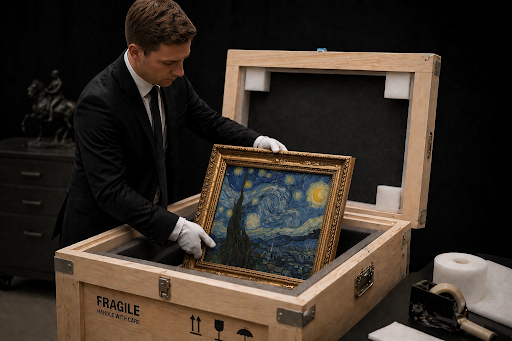
Soft-Packing Versus Custom Crating
Not every work needs a wooden crate, and not every work is safe in a padded wrap. The distinction is one of the first things our handlers settle, because it shapes everything that follows. Soft-packing means surrounding a piece in layers of protective material without an outer rigid shell: archival tissue or glassine against the surface, foam or bubble around the frame, then a moving blanket and corner protection. It is appropriate for short, handled moves where the work stays under direct supervision from origin to destination, such as a framed painting going across town for an installation.
Custom crating means building a rigid wooden enclosure sized to the individual piece, with interior bracing that immobilizes the work and cushioning that absorbs road shock and impact. Crating becomes the right choice the moment a work leaves direct supervision: long transit, freight handling, storage stacking, or any journey where the piece will be set down, picked up, and moved by people who cannot see what is inside. A crate is also the honest answer for anything fragile or high in value, because the cost of the crate is small next to the cost of the work.
Crate Types and When We Build Them
We match the crate to the piece and the journey rather than reaching for one standard box. The common forms include the following.
- Travel frame. A lightweight wooden frame that floats a framed painting away from the crate walls, used for shorter trips and lighter works where full enclosure is more than the journey requires.
- Slat crate. An open-frame wooden structure that protects edges and corners while keeping weight and bulk down, suited to large flat works moving under careful handling.
- Solid panel crate. A fully enclosed wooden box that seals the work away from light, dust, and incidental contact, the default for long-distance shipping and freight transit.
- Double-wall, museum-grade crate. A crate within a crate, with an insulating air gap and dense interior cushioning, built for the most fragile, high-value, or irreplaceable works and for long journeys where temperature and shock are outside our control.
Each crate is built to the dimensions of the specific work. Interior bracing holds the piece steady so that it cannot shift, and surface-contact materials are chosen so that nothing abrasive or acidic ever touches the work itself.
How Packing Changes With the Medium
The medium dictates the method. A handler who treats every object the same way will eventually damage something, so we pack to the vulnerabilities of each kind of work.
- Framed paintings with glass. The glazing is taped in a grid so that if it breaks, the shards stay against the tape rather than falling onto the surface beneath. The face is protected and the frame corners are guarded before the piece is wrapped or crated.
- Unframed canvas. A stretched canvas is most at risk from pressure on its face and from corner knocks. We keep all contact away from the painted surface, support the stretcher, and never let anything press flat against the canvas plane.
- Works on paper. Prints, drawings, watercolors, and photographs are interleaved with acid-free tissue or glassine and kept rigid and flat, because creasing and surface contact are the real enemies. Humidity-sensitive pieces travel with moisture-control packets.
- Sculpture and three-dimensional work. Bronze, stone, ceramic, and mixed-media objects need custom bracing that distributes weight and immobilizes projecting or delicate elements. Heavy pieces are blocked so that their mass cannot shift inside the crate during transit.
Surface Protection and Immobilization
Two principles govern every job. The first is surface protection: whatever touches the work must be inert and gentle. Acid-free tissue, glassine, and archival interleaving papers sit in direct contact with the piece, and foam, corner protectors, edge bumpers, and frame guards sit outside that first layer. Nothing acidic, abrasive, or adhesive ever reaches the work itself.
The second principle is immobilization. A packed piece that can still move can still be damaged. Custom bracing and tensioned cushioning hold the work in a fixed position so that road shock, sudden stops, and handling jolts are absorbed by the packing rather than transmitted to the art. The materials we keep on hand for this include the following.
- Custom-built wooden crates sized to the work with internal bracing
- Archival tissue, glassine, and acid-free interleaving papers
- Shock-absorbing foam padding for cushioning and immobilization
- Corner protectors, edge bumpers, and frame guards
- Moisture-control packets for humidity-sensitive pieces
- Tamper-evident sealing for chain-of-custody on loans and consignments
When Professional Crating Is Required
Some journeys leave no room for a judgment call. Professional crating is the appropriate standard for long-distance and international shipping, for freight handling where the work passes through hands that cannot see inside the box, for long-term storage where pieces are stacked and shelved, and for any work that is fragile, irreplaceable, or high in value. It is also the right choice when insurance-grade documentation and chain-of-custody matter, as with museum loans, gallery transfers, and estate transitions where several parties handle a piece before it reaches its destination. When the journey is short and supervised, soft-packing is often enough, and we will tell you so rather than sell a crate that the trip does not need.
Documented at Every Step
Before a crate closes, each piece is photographed and its condition is noted, and that record is repeated at intake and at release. The result is a documented account of the work's state at every transition, which supports insurance claims, estate records, and verification at the destination. Packing rarely stands alone, so we coordinate it with local art transportation for the move that follows, with climate-controlled fine art storage when the piece is going into long-term care, and with cataloging and condition reporting when the collection needs a formal inventory. When a crated work arrives at its final wall, our art installation team can hang it, closing the loop under one accountability trail.
Frequently Asked Questions About Art Packing & Crating
Do I need a custom crate or will a padded wrap work?
It depends on the piece and the journey. A framed piece traveling across town for a gallery installation under direct supervision often only needs proper soft-packing and careful handling. A work going into long-term storage, a fragile or high-value piece, or a piece traveling a longer distance is better served by a custom crate. We make the recommendation at the quote stage based on the specifics of your engagement.
What is the difference between soft-packing and crating?
Soft-packing surrounds a work in protective layers without a rigid outer shell and suits short, supervised moves. Crating adds a custom wooden enclosure with interior bracing that immobilizes the work, and it is the right choice once a piece leaves direct supervision, such as freight transit, storage, or long journeys. The fragility and value of the work also push the decision toward a crate.
How do you protect the glass on a framed painting?
We tape the glazing in a grid pattern before packing. If the glass breaks during transit, the tape holds the shards in place against the surface of the glass rather than letting them fall onto the artwork beneath. The frame corners are then guarded and the face is protected before the piece is wrapped or crated.
Can you pack at my home or gallery?
Yes. For most clients, we pack at the origin location. Our team brings materials and tools, packs each piece carefully on site, and then transports the packed works to their destination. This is often safer than moving pieces unpacked to a packing station, because every inch of unprotected transit is a risk.
For more general questions, see our full FAQs page.