Why a Stable Environment Decides Whether Art Survives
Most damage to fine art does not come from a single dramatic event. It comes from the room. A canvas expands and contracts every time the temperature shifts. Paper draws moisture out of humid air and gives it back when the air dries, and that constant breathing eventually cockles the sheet and lifts the medium off its surface. Wood panels and frame joints move along the same lines. Each cycle is small, but the cycles never stop, and the harm accumulates until it becomes visible long after it became permanent.
This is the reason a storage facility built for art is not the same thing as a self-storage unit that happens to be indoors. Vidro Art Storage holds temperature steady at 70 degrees Fahrenheit and relative humidity at 50 percent, the museum benchmark for long-term preservation. The value is not the number on a single afternoon. It is the steadiness. When conditions hold flat month after month, paint layers, canvas, wood, and paper reach a moisture equilibrium and stay there, and the slow back-and-forth that cracks, warps, and clouds a piece simply does not get the chance to start. A garage, an attic, a spare room, or a metal self-storage locker swings with the weather outside. A purpose-built room does not.
Inside the Storage Environment
The facility sits in downtown Los Angeles and is configured around the work rather than around square footage. Air is kept clean and dust-free with controlled airflow, because settled grit is abrasive and traps moisture against a surface. Light is kept off the work in storage, which removes the ultraviolet exposure that fades pigment and yellows varnish over time. Fire protection and disaster-preparedness measures are part of the building, not an afterthought added later.
Access is deliberately narrow. The facility runs 24/7 security with restricted, key-card entry and video surveillance, so the people who can reach the storage area are a short and known list. That matters for two reasons at once. It protects the work from theft, and it protects the work from casual handling, because a piece that nobody touches without a reason is a piece that does not get bumped, leaned, or shifted by accident.
How Pieces Are Stored and Tracked
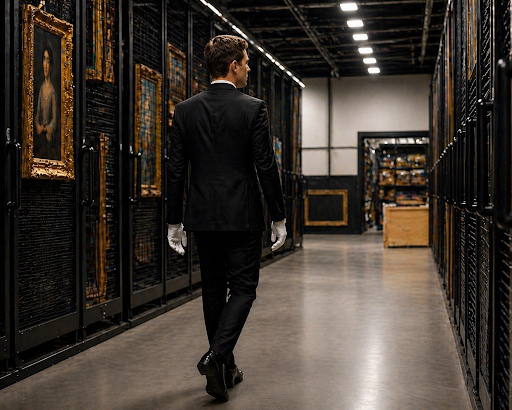
Not every object wants to be stored the same way, so the space is not one open room with everything stacked together. Framed paintings are racked vertically so nothing rests its weight on the work below it. Oversized, unusually shaped, or especially fragile pieces are given custom racking or are crated, which is where coordinated professional packing and crating becomes part of the storage plan rather than a separate errand. Works on paper, photographs, and textiles are handled flat or housed in a way that keeps them from bearing stress along a single edge.
Every object that comes in is logged. Each piece is photographed and condition-noted at intake, placed in the facility, and tracked in our internal inventory so its location is always known. That record is what makes retrieval orderly instead of a search. When a client adds a coordinated cataloging and inventory record, the storage account and the documentation line up against the same set of images and notes, which keeps a growing collection legible over years.
The Intake and Retrieval Workflow
- Pickup or delivery. We collect the work from your location with coordinated climate-controlled local transportation, or you arrange delivery to the facility. Either way the move into storage is treated as carefully as the storage itself.
- Documented intake. Each piece is photographed and condition-noted before it is placed, so its state at the moment it entered is on the record.
- Placement and tracking. The work is racked, shelved, or crated according to what it needs, then entered in inventory with its location.
- Retrieval on your schedule. When a piece is needed, we pull it and coordinate its return, whether that is to a gallery wall, a residence after renovation, or onward for professional installation. Condition is documented again at release so anything that changed during storage, however rare, is captured.
Short Stays and Long Stays
Storage gets used on two very different clocks, and both are welcome. A short stay is often transit housing: a collection waiting out a home renovation, pieces held between residences during a move, or work parked safely for a few weeks while a wall is being prepared. The collection does not belong in storage forever, but for that window it needs somewhere that will not harm it.
A long stay is different in intent. It covers pieces that are not currently on display, a rotation that exceeds the wall space available, consignments and inventory held between exhibitions, and works kept safe while decisions about a sale, a gift, or an estate are still being made. The same steady conditions serve both timelines. The difference is only how long the equilibrium needs to hold, and steady conditions do not get tired. Terms are flexible and can be adjusted as a short stay turns into a long one or a collection grows.
What Sets a Storage-Specific Facility Apart
The plainest way to describe the difference is this: a self-storage company sells you empty space and leaves the conditions inside it to chance, while a fine art storage facility sells you the conditions and treats the space as the means to deliver them. The climate, the airflow, the light control, the racking, the security, and the documented chain of custody are not amenities bolted onto a warehouse. They are the product. Every object is handled by people trained for it, logged at every transition, and tracked by a named coordinator the client can reach, so the question is never where a piece went or who last touched it. That is the line between holding a collection and merely housing it.
Frequently Asked Questions About Fine Art Storage
What types of artwork do you store?
We store paintings, works on paper, photographs, sculpture, textiles, mixed media, and framed works of any size. Oversized or unusually shaped works are accommodated with custom racking. If you have an unusual piece or are unsure whether it fits, a brief description at the quote stage is usually enough to confirm.
Why does holding 70 degrees and 50 percent humidity matter so much?
It is the steadiness rather than the exact reading that protects the work. At a stable 70 degrees Fahrenheit and 50 percent relative humidity, the materials in a piece reach a moisture balance and stay there. When temperature and humidity swing, those materials expand and contract repeatedly, and that cycling is what eventually cracks paint, cockles paper, and loosens joints. Holding the conditions flat removes the cause rather than treating the symptom.
How is this different from a regular self-storage unit?
A standard self-storage unit gives you empty space whose temperature and humidity follow the weather outside, with open access and no record of the condition of what you put inside. A fine art facility is built the other way around. Conditions are held steady at the museum standard, access is restricted with 24/7 security, key-card entry, and video surveillance, and every piece is photographed, condition-noted, and tracked in inventory from intake to release.
For more general questions, see our full FAQs page.