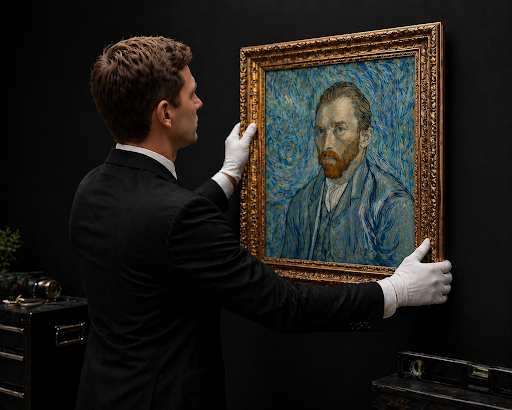
The Wall Decides the Hardware
No two walls hold a picture the same way, and the single most common cause of a fallen work is hardware chosen for the frame rather than for the surface behind it. Before any hole is made, we identify what we are anchoring into. Drywall over wood studs takes one approach, hollow drywall between studs takes another, and lath-and-plaster, solid masonry, brick, and poured concrete each demand their own anchors and bits. A toggle or molly bolt rated for a light frame on drywall is the wrong choice for the same weight on plaster, and neither belongs in concrete. We match the anchor to the wall and to the load, then add a margin so the hardware is never working at the edge of its rating.
Weight changes the method as much as the wall does. A small canvas on a single picture hook is one task. A large mirror, a heavy framed work under glass, or a multi-panel piece is another, and those go up on two-point hangs or on a French cleat that distributes the load across the wall and locks the piece down so it cannot be lifted off by a casual bump. For valuable or vulnerable works we install security hangers and locking cleats so the piece resists both theft and accidental knocks. Heavy works are lifted by two handlers, never wrestled by one, and we protect the floor and adjacent surfaces before the piece ever comes off its packing.
Height, Spacing, and Sightlines
Placement is where a professional hang separates itself from a confident guess. As a general convention, a single work is centered so that its visual center sits near eye level for a standing viewer, then adjusted for the room: a piece above a sofa, a console, or a mantel relates to that furniture rather than to an abstract rule, and a piece in a stairwell or a tall entry is read on the diagonal as people climb. We dry-fit placement, check it from where people will stand, and confirm the level twice before the work is set.
Groupings ask for more planning, not less. For a pair, a triptych, or a tightly spaced grid, consistent gaps are what make the arrangement read as intentional, so we map the layout before drilling. A salon-style wall, where works of different sizes are massed together, is laid out on the floor or templated in paper on the wall first, so the composition is resolved while it can still move freely. Only when the arrangement is right do the anchors go in. This is the same discipline that makes a wall of catalogued works easy to track later, and it pairs naturally with our art cataloging and inventory service when a collection is being documented as it goes up.
Large, Heavy, and Awkward Pieces
The pieces that worry collectors the most are the ones we plan for the most. Oversized canvases, framed works that exceed a single person's reach, mirrors whose weight is concentrated in glass, and multi-panel installations that must align across several anchor points all call for staged handling. We confirm the route into the room, the clearance through doors and around corners, and the lift before the work leaves its wrapping. For unusually heavy or oversized works we fabricate or source custom brackets rather than forcing a stock hook to do a job it was never rated for. When a piece arrives crated or wrapped for a move, the install follows cleanly from our professional art packing and crating work, so the handlers placing it on the wall already know exactly how it was protected on the way in.
Residential Versus Gallery and Exhibition Installs
A home install and a gallery install share the same care but answer to different priorities. In a residence, the work fits a lived-in room: it relates to furniture, to natural light through windows that move across the day, and to a family that walks past it, so security hardware and a clean, unobtrusive finish matter. We respect the home, protect floors and finishes, and leave the space exactly as we found it apart from the work now on the wall.
A gallery or exhibition install answers to the show. Spacing is consistent across a run of works, heights are held to a common centerline so the eye travels smoothly down the wall, and labels, lighting, and de-install dates are part of the plan from the start. Rotating shows mean works come down as carefully as they went up, often on a schedule, and we map placement in advance so an opening is never waiting on the wall. We work directly from a gallery layout or a designer plan, and we can consult on placement when there is no fixed plan yet. Whether the setting is a single living room or a full exhibition, the standard is the same: level, centered, securely mounted, and documented.
De-Installation and the Move That Follows
Taking work down is its own skill. Pieces come off the wall in the reverse of the care that put them up, anchors are removed cleanly, and the work is protected the moment it leaves the wall. De-installation is often the natural start of a relocation, a renovation, or a show transition, so we can combine it with packing and with local art transportation across Los Angeles, and with fine art storage when a collection is going into climate-controlled care between homes or between shows. Keeping the take-down, the move, and the storage under one set of handlers means the work is touched by people who already know it.
Frequently Asked Questions About Art Installation
How do you choose the right anchor for my wall?
We identify the wall construction first. Drywall on studs, hollow drywall, lath-and-plaster, brick, masonry, and concrete each take different anchors and different bits, and we select hardware rated above the weight of the piece so it is never working at its limit. For heavy works we use two-point hangs or a French cleat to spread the load.
Can you secure valuable or heavy pieces against theft and knocks?
Yes. For valuable or vulnerable works we install security hangers and locking cleats that hold the piece tight to the wall so it resists both theft and accidental bumps. Heavy mirrors and large framed works are lifted by two handlers and mounted across multiple anchor points.
Will you work from a designer plan or a gallery layout?
Yes. We install directly from interior designer plans, gallery layouts, and client placement guides, holding consistent spacing and a common centerline for runs of works. For salon walls and grids we template the layout in advance so the composition is resolved before any anchor goes in. We can also advise on placement when there is no fixed plan.
Do you handle de-installation and the move afterward?
Yes. We take pieces down with the same care we use to hang them, remove anchors cleanly, and protect each work immediately. De-install is often combined with packing, transport, and storage for renovations, relocations, and gallery show transitions, all handled by the same team.
For more general questions, see our full FAQs page.