The Most Dangerous Moments in a Work's Life Happen on the Road
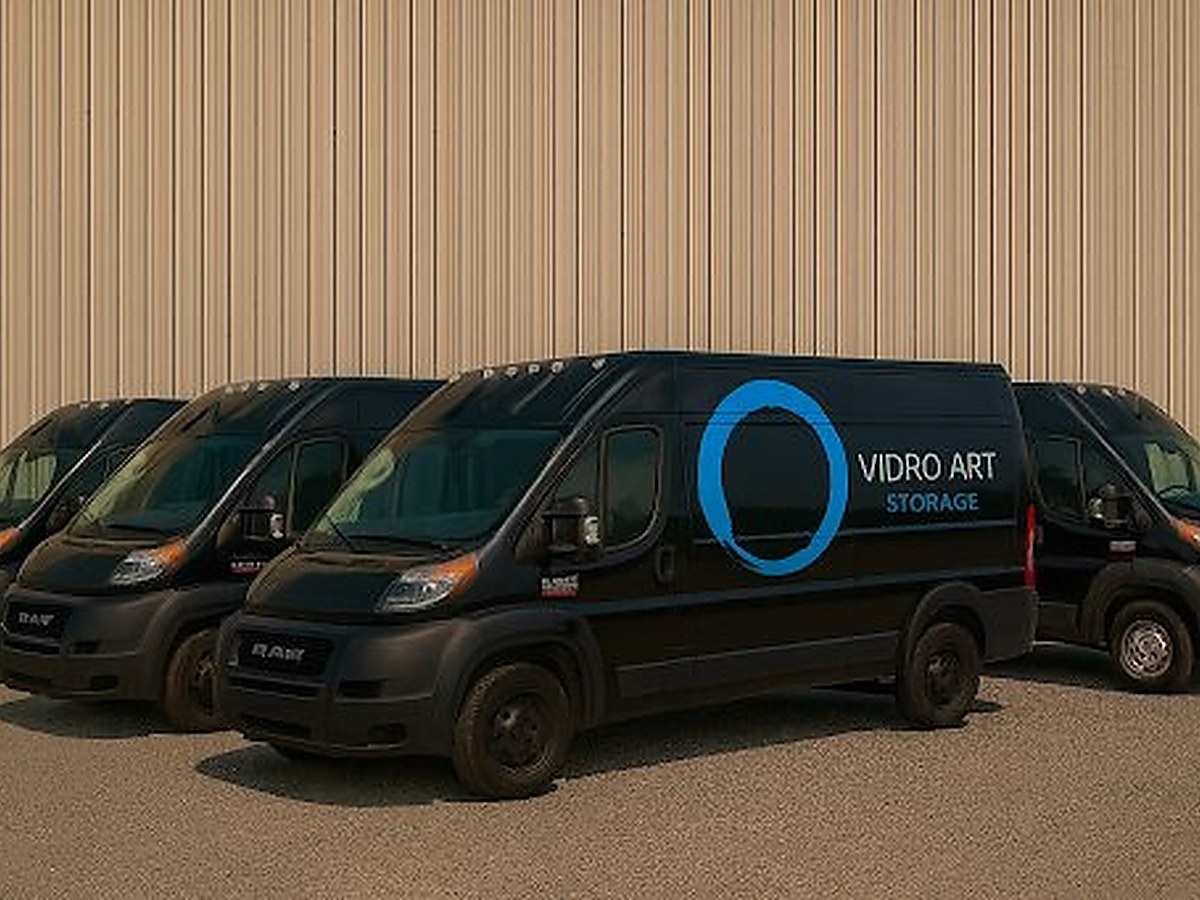
A painting can sit safely on a wall or inside a climate-controlled vault for years without incident. The risk concentrates into the short window when it leaves one address and travels to another. Vibration from a rough roadway, a sudden temperature swing between a cool gallery and a hot loading dock, a tight turn through a residential stairwell, a piece that shifts because it was not immobilized properly: these are the failure points that local art transportation exists to remove. Vidro treats every move across Los Angeles as a controlled extension of storage, not as a delivery run that happens to carry something fragile.
The work begins before a single piece is lifted. We ask about the dimensions and medium of each item, the access conditions at both ends of the trip, and the timing constraints that frame the move. That information shapes the vehicle, the wrapping method, the size of the team, and the route.
Climate-Controlled and Air-Ride Transport
Two vehicle characteristics matter most for fine art in transit. The first is climate control, which holds temperature and humidity steady so a work does not experience the same shock it would in an ordinary truck baking in afternoon traffic. A piece that has been conditioned to a stable storage environment should not be asked to swing twenty degrees on the way to its destination. The second is ride quality. Air-ride suspension and careful route planning reduce the road vibration that, over enough miles, loosens joints, stresses old canvases, and chips fragile surfaces. Sensitive works are moved with both factors in mind so that transit conditions stay close to the conditions the work is used to.
Blanket-Wrap Versus Crated Transport
Not every move calls for the same level of enclosure, and matching the method to the work is part of doing the job well.
- Blanket-wrap transport suits framed paintings, mirrors, and sturdy objects moving a short distance under direct supervision. Each piece is padded, wrapped, edge-protected, and loaded so that soft and hard surfaces never touch. This is efficient for local moves where the team stays with the work from pickup to delivery.
- Crated transport is the right call for delicate, high-value, irregular, or unusually large works, and for anything that will be staged, stored, or handled by more than one party along the way. A custom crate built through our professional art packing and crating service gives a rigid shell, internal cushioning, and a defined orientation that protects the piece even when it leaves our direct line of sight.
When a move mixes both, we plan the load so that crated and blanket-wrapped pieces are separated and braced independently.
Securing and Immobilizing Work in Transit
A piece is only as safe as the way it is held in place. Inside the vehicle, each work is positioned, padded against the walls and against its neighbors, and strapped so that it cannot slide, tip, or rub during acceleration, braking, or turns. Soft padding sits between every contact point. Heavier and larger items are braced low and against the structure of the vehicle, while smaller works are kept from shifting into open space. Immobilization is the quiet discipline that separates professional handling from an ordinary load, and it is checked before the doors close.
Chain of Custody and Condition Reporting
Documentation travels with the work. At pickup, each piece is identified and its condition is noted before it is wrapped, so there is a clear record of how it looked when it left the origin. At delivery, the same pieces are inspected again and condition is documented at release. This pickup-to-delivery record forms a chain of custody that matters to collectors, gallery registrars, and institutions alike, and it pairs naturally with our art cataloging and inventory service when a collection needs formal records maintained over time.
Planning the Move: Access, Elevators, Stairs, and Parking
Most transport problems are access problems in disguise. A door that is two inches too narrow, an elevator that will not fit a large frame, a flight of stairs with a tight landing, or a building with no nearby loading zone can turn a simple move into a difficult one if it is discovered on the day. We plan around these conditions in advance. Before the move we confirm how a work will leave the origin and enter the destination, whether a freight elevator or stairwell is the safer path, where the vehicle can park to shorten the carry, and what delivery window a building or gallery requires. For deliveries to galleries, museums, and managed buildings, we coordinate directly with registrars, collections staff, and facilities managers to reserve loading dock access and schedule the arrival. That preparation is what keeps a move calm and on schedule.
Single-Piece Moves and Full-Collection Relocations
The service scales to the scope of the work. A single framed piece traveling across town is a complete engagement on its own, with no requirement to bundle it into a larger job. At the other end of the range, relocating an entire collection between residences, or moving a body of work out of a home during a renovation, calls for sequencing, labeling, and a load plan that keeps every piece tracked from origin to destination. Many moves also connect to our other services: works heading into long-term care arrive through fine art storage, and works arriving at their final wall can be hung the same visit through art installation. One team carrying a piece from pickup to placement keeps a single accountability trail across the whole engagement.
Serving Los Angeles Galleries, Residences, and Fairs
Vidro provides local art transportation throughout Los Angeles, Beverly Hills, Santa Monica, Hollywood, Orange County, and the surrounding greater Los Angeles area. We move work to and from private residences, between galleries for pieces on loan, from artist studios to exhibition space, and to and from art fairs where timing and dock coordination are tight. Common routes include a pickup in Beverly Hills with delivery to our downtown facility, gallery-to-residence moves through Hollywood, and coastal pickups in Santa Monica and the Palisades. Knowing the loading docks, building managers, and neighborhoods of the region is what lets us prevent surprises and hold to the schedule a collector or gallery is counting on.
Frequently Asked Questions About Art Transportation
What areas do you serve for art transportation?
We provide local art transportation throughout Los Angeles, Beverly Hills, Santa Monica, Hollywood, Orange County, and the surrounding greater Los Angeles area. If you are outside that area, call us anyway, because we have handled pickups and deliveries to locations that were not on our initial list.
How do you decide between blanket-wrap and crated transport?
The decision comes down to the fragility, value, size, and journey of the work. Sturdy framed pieces moving a short distance under our direct supervision travel well blanket-wrapped, while delicate, high-value, oversized, or multi-stop works are better protected in a custom crate. We recommend a method at the quote stage once we know what is moving and where it is going.
Do you handle stairs, elevators, and tight entryways?
Yes. Our teams handle oversized and fragile pieces through residential staircases, apartment elevators, gallery loading docks, and narrow entryways. A brief note about access conditions at both ends during the quote stage helps us arrive with the right equipment and the right plan.
Can you coordinate with galleries, museums, and art fairs for delivery?
Yes. We coordinate directly with gallery registrars, museum collections staff, art fair logistics, and building facilities managers to schedule loading dock access, delivery windows, and chain-of-custody paperwork so the arrival lands within the time frame each venue requires.
For more general questions, see our full FAQs page.