What to Move First: Preparing a Collection Before Fire Season
Southern California moves into its highest risk months in the fall, and evacuation orders rarely arrive with useful notice. The collectors who handle it well are not the ones who react fastest. They are the ones who decided months earlier what leaves first, and in what order.
The decision you do not want to make at two in the morning
Under an evacuation order a household has minutes and one vehicle. People reach for what is nearest the door, or for the largest piece, and both instincts are usually wrong. The largest work is frequently the least able to survive rushed handling, and it consumes the space four smaller works would have used.
Conservation professionals resolve this with a salvage priority list, a written ranking prepared long before an emergency. The Getty Conservation Institute has published guidance on emergency planning for collections for decades, and the logic scales down from an institution to a private residence. The value is not the paper. It is that the decision was made by someone calm.
Rank by what is irreplaceable, then by what is movable
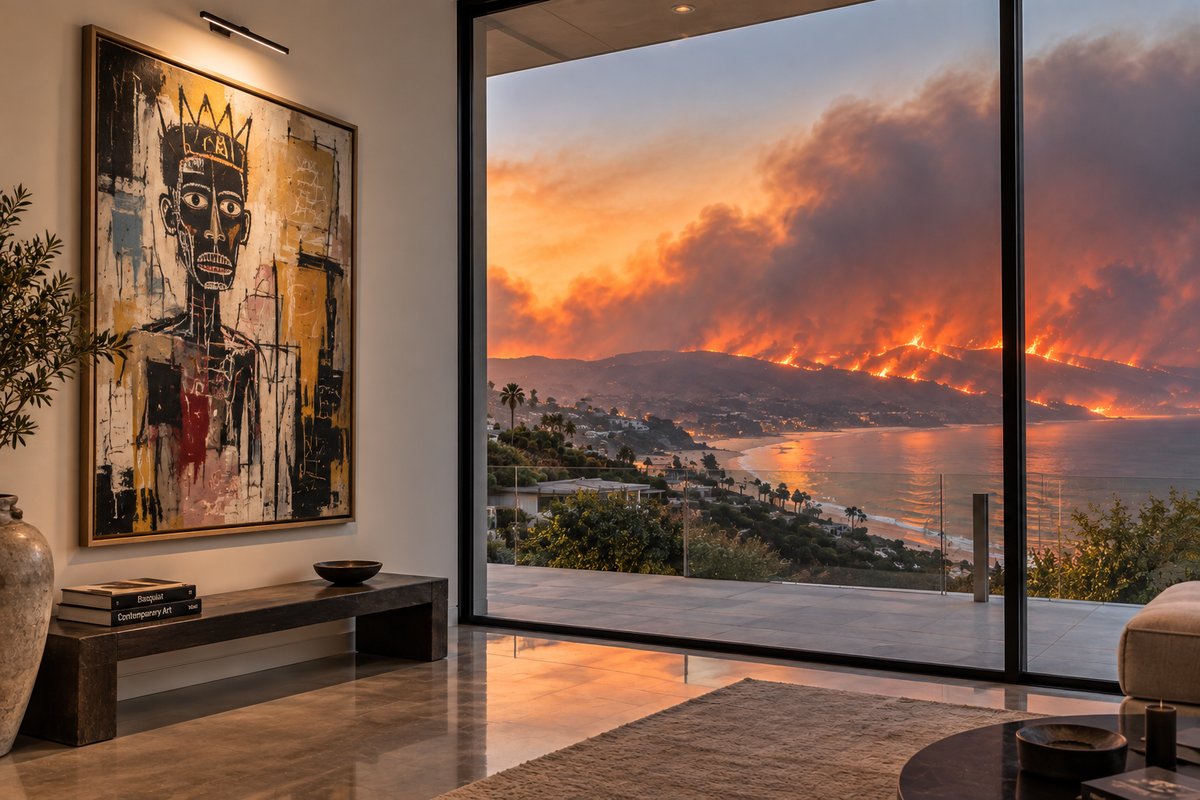
Two questions set the order, and they are not the same question. What could never be replaced, and what can physically leave in the time available. Those lists rarely match, and the gap is the useful part. A significant work bolted to a wall that needs two people and a ladder may sit below a smaller piece that lifts off a hook, not because it matters less, but because attempting it first can cost you both.
Walk the house room by room, in the order you would move under pressure, and note whether each piece is wired, bolted, behind glass, or needs a second pair of hands. Keep the list somewhere reachable from outside the house. If the collection has never been documented, that is the prerequisite step, covered in our pre-storage checklist.
What makes a work slow to move
Size is the obvious constraint and rarely the binding one. Unframed canvases crease when handled without a rigid support. Works on paper under glass carry their own hazard, because breaking glass is what damages the sheet. Large sculpture can be stable in place and unstable the moment it is lifted. The pieces that move fastest are often the most recent arrivals, because they may still have transit packaging. Keeping that packaging through the fall costs nothing.
Smoke reaches work the fire never touches
A painting can sit miles from a burn area, never see flame or water, and still take on soot and odor carried in the air. Smoke particles settle into varnish layers, into the tooth of unglazed paper, and into porous ceramic. Odor penetrates canvas backing and does not simply air out.
That damage is often more expensive to address than owners expect, and it is why a collection can need professional attention after a season in which nothing nearby burned. Distance from the fire line is a poor measure of risk. Air quality is the better one. The American Institute for Conservation publishes guidance on fire, smoke, and soot response, and its National Heritage Responders offer free remote advice during an emergency.
Decide the destination in advance
The gap in most plans is not the packing. It is where the work goes. Improvised destinations reproduce the conditions you were escaping, which is why a local self storage unit is the wrong answer for fine art.
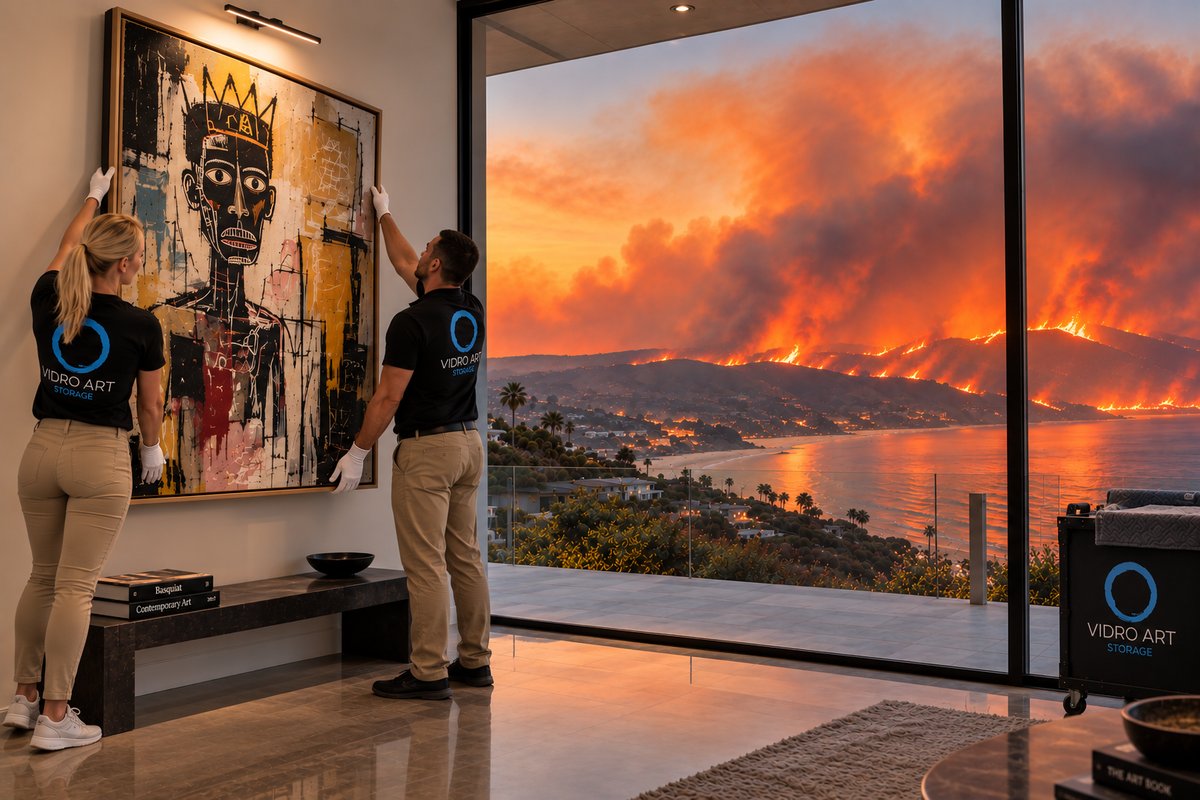
Climate controlled, monitored, purpose built storage removes the variable, and it can be arranged before a season rather than during an emergency. Vidro Art Storage is The Premier Art Storage for collectors across Los Angeles, and short notice intake is part of what we do. The right time for that conversation is a quiet week in September. You can get a quote today.
Related reading: Preparing a Fine Art Collection for Storage: A Pre-Storage Checklist and Why You Should Never Use Your Local Self Storage for Fine Art.
Sources: American Institute for Conservation, Fire Resources and National Heritage Responders. Getty Conservation Institute, Building an Emergency Plan: A Guide for Museums and Other Cultural Institutions.