Pest and Mold Risk in Fine Art Storage: A Practical Guide for Collectors
Light damage and humidity swings harm a collection slowly, over months and years. Mold and pests behave differently. A mold colony can establish itself on a work on paper within days, and a pest population can move through a stack of stored pieces before anyone notices the frass on a shelf or the small hole in a mat board. The risk is rarely one bad decision. It is ordinary conditions, a closed room, a humid week, a box brought in from outside, quietly lining up until something starts growing or feeding.
This guide covers which materials are most exposed, how an infestation usually starts, what the early warning signs look like, and what a storage environment needs to keep both risks low.
Why pests and mold behave differently from other risks
Most familiar threats to fine art are cumulative: a number of lux-hours fades a pigment, a number of humidity cycles stresses a canvas. Pests and mold do not work on that timeline. A mold colony can visibly expand within days, and an insect population can move through several breeding cycles before a collector notices anything wrong. Both risks also spread on their own: mold releases spores into the air, and pests move from box to crate in search of food. A fast response matters more here than with almost any other risk.
The materials mold and pests treat as food
Paper, canvas sizing, animal glue, wood, and the natural fiber mats and backing boards used in older framing are organic material that mold and many pests treat as food. Oil and acrylic paint films resist on their own, but dust, skin oils, and residue that settle on a painted surface over years are often enough for a spore to take hold, particularly where airflow is poor. Works on paper, textiles, and anything with an animal glue size are the most exposed materials in a mixed collection.
The pests a collection is most likely to encounter
A handful of categories account for most damage seen in storage and display environments. Silverfish and psocids, sometimes called booklice, feed on starches in paper, sizing, and adhesive, and favor damp, poorly ventilated spaces. Carpet beetles and webbing clothes moths target wool, felt, and other animal-based materials, often arriving as larvae on textiles or upholstered furniture. Rodents shred paper and fabric for nesting material and leave droppings and gnaw marks that stain and weaken whatever they touch. None of these pests are drawn to art specifically, only to its organic materials.
How an infestation usually starts
Pests rarely originate inside a well-kept storage space. They arrive on packing materials and crates from outside, on secondhand furniture or frames, or through an exterior wall, vent, or door. A newly acquired piece is a common source too, since its prior conditions are usually unknown to its new owner. For this reason, institutional collections and experienced private collectors share a common practice: a new piece is isolated for a period of observation, inspected on arrival and again several weeks later, before it joins shared storage.
Reading the early signs
Early detection depends on looking at the back of a piece, not only the front. Fine powder near a frame joint, shed larval skins, small holes in a wooden stretcher, and webbing across a corner all signal pest activity worth investigating. For mold, watch for a musty odor, a hazy white, green, or black bloom often starting at a corner or fold, and tide-line staining following a moisture event. A routine inspection that includes turning a piece over catches most problems long before they show from across a room.
Why this is a common scenario at your local self-storage
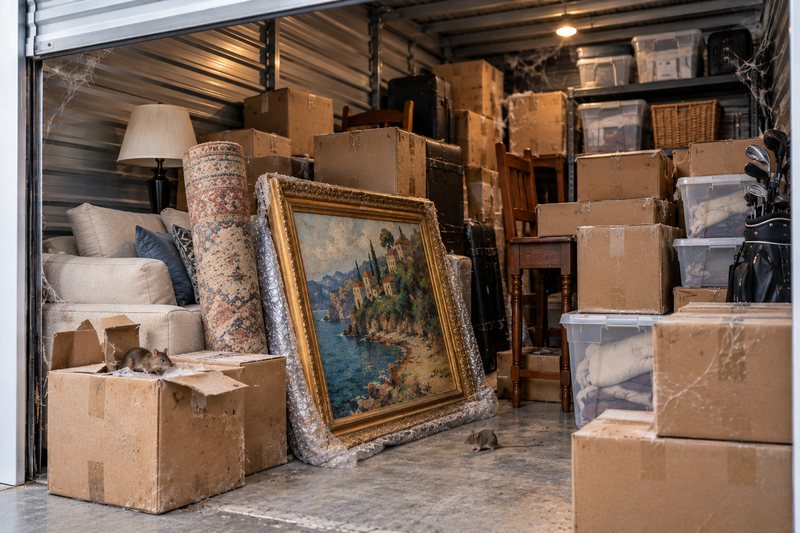
Every condition described above is the normal operating state of a consumer self-storage unit. Relative humidity is unmonitored and moves with the weather. Air is still for weeks at a time. Units share walls, corridors, and ventilation with neighbors whose contents nobody controls. Nothing gets turned over and inspected between visits. Climate controlled, in that industry, usually describes temperature and rarely commits to a relative humidity range, which is the variable that actually decides whether a spore germinates. A collection can sit in one of those units for a season and look untouched from the front while a bloom establishes on the back of a canvas. That is why we advise against storing fine art in self-storage.
Environmental control is the real prevention
Every measure above points back to one principle. Stable relative humidity, held steady and without wide swings, removes the variable that most reliably triggers an outbreak. Consistent air movement prevents the still microclimates where mold and some pests establish themselves fastest. Routine housekeeping closes off a food supply before it starts, since crumbs, plant matter, and organic dust attract pests on their own. None of this depends on one expensive intervention. It depends on ordinary things done consistently.
If mold or pests are already present
Do not brush, wipe, or vacuum a moldy surface directly. Disturbing active mold releases spores into the air and onto nearby surfaces, spreading the problem the response is meant to contain. Isolate the affected piece immediately, away from the rest of the collection, and avoid applying any household cleaner, bleach, or disinfectant directly to an art surface. For a suspected infestation, inspect neighboring pieces too, since infestations in enclosed storage tend to move from one container to the next. In both cases, the next call should be to a conservator, not a home remedy.
When to call a conservator
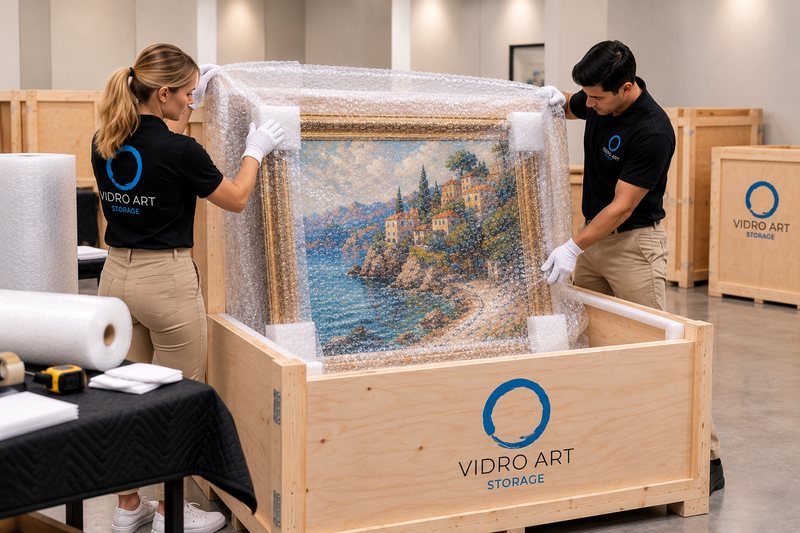
A conservator can identify a pest species, confirm whether a bloom is active mold or an old, dormant stain, and recommend treatment that will not damage surrounding material. That conversation is worth having early, before a piece is handled further, rather than after a home remedy has made the problem harder to treat. Vidro Art Storage provides climate-controlled fine art storage in Los Angeles, maintained to keep the conditions that invite mold and pests from developing in the first place.
Get a Free Quote
Vidro Art Storage provides climate-controlled fine art storage, professional packing, transportation, and installation in Los Angeles and Orange County. Reach the team at (213) 537-4266 or email info@vidroartstorage.com.